Science Sunday::"The Coanda Effect "
When this experiment showed up in my email box, I knew the boys would love it. And it is very, very simple!

Step 1
Put a candle behind a box and try to blow it out.
(it does not show in the picture, but James blew really, really hard to try and blow the candle out)

Step 2
Repeat the experiment, but this time use a round can.
(with no effort, the candle blew out)
"In the 1930’s Henri Marie Coanda discovered that a fluid (air is a fluid) has a
tendency to follow a curved surface."
For a complete explanation of this experiment,
you can visit Exploration Education's Newsletter for April.
you can visit Exploration Education's Newsletter for April.
(I don't want to break any copyright laws!)
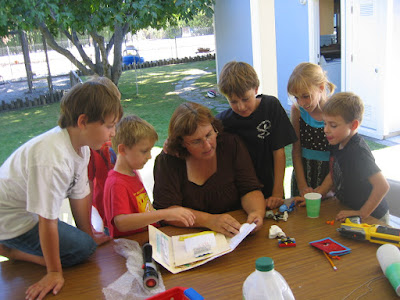
I am so glad that dad sat down with the boys to do this experiment. They applied the discoveries made with experiment in talking about car design, airplanes, how smoke could be blown through a fan to determine airflow around a model.... how computers have changed how things are designed... I have to say that the conversation was moving pretty fast and I was cooking, so I may be mixing things up a bit, but dad's enthusiasm was contagious!!
Showing how water hugs the glass all the way around (like the air).



Very cool! I'll need to do this with mine.
ReplyDeleteWhat a great experiment!
ReplyDeleteThat is a cool experiment...air is a liquid? I always thought it was a mixture of gasses. Perhaps it acts like a liquid?
ReplyDeleteThat is such a very cool experiment. Prepare to impress my kids!
ReplyDeleteI have learned so much from this that we are going to be doing a whole unit on fluid dynamics and we will be repeating this experiment as our introduction. Thank you so much!
ReplyDelete